Pages

Showing posts with label My Brother Tootoo. Show all posts

Monday, January 3, 2011

Writing and reading My Brother Tootoo

Hello reader. Hello brand new year. As a new year begins, spare a thought for the near and dear ones of authors who are caught in the final throes of finishing a book. If you can't imagine what that must be like, Nandita Mahajan, daughter of author Urmila Mahajan, gives us a ring-side view of the action plus an intimate review of My Brother Tootoo


When my mother first told me she was writing a book, I wasn’t that surprised. She has always been one for inventing stories. When I was a child I’d heard several of them, all tailor-made to fit my interest. So, writing a book seemed to me a very characteristic and predictable thing for her to do. My lack of surprise however, only lasted until I read it.

The first time I read My Brother Tootoo, it was still unfinished and unpolished. However, being a literature student and having read hundreds of books myself, I could tell that this was turning out to be a really unusual one. Even though the plot hadn’t quite been formed yet, it was the astounding portrayal of characters that stood out from the beginning.

Before long, I became the guinea-pig. I was made to read the book at various stages of development, and offer suggestions. As the rate of its production accelerated, however, I didn’t get to see the excerpts as often as before and my mother was often staying up till late at night, writing. I next read it as a finished product, after it was published.

To call My Brother Tootoo a children’s adventure story would be a gross underestimation. As I went deeper into the novel, I found that it is rich in meaning and is among other things, a study of human nature. It is a story within a story. Rini, a sensitive girl of about fifteen, writes about the events of three summers ago, in the hope that they will “feel like a story about someone else.” At the same time, she writes a diary, giving the reader a glimpse into the present. The opening line of the book seems to be a premonition of things to come.

Dear Diary,
Mama says home is a place where at some time or the other, everything has happened.


We are introduced to Rini’s brother Tootoo, who is a late talker, and Murli, the son of the local presswallah. The three become friends, despite Rini’s initial disapproval of Murli’s disobedient, headstrong nature. Before long, the children find themselves in the middle of an unexpected adventure.

The novel’s remarkability lies largely in the perceptiveness of Rini’s narrative. The events themselves, though extraordinary, could have happened to anyone. I think that it is in my mother’s view of the world that she shows her true genius. The story is set in a regular Indian city, and is about a seemingly ordinary family that consists of a mother, a father, a grandmother and two children. Yet, as the story unfolds we find that there is more to each character than meets the eye, and people are often much more than they seem to be. The theme of appearances versus reality runs throughout the novel and adds to its sense of secrecy. It is the pursuit of secrets that leads the children into forbidden domain, to a point of no return.

The characters of the three children in particular are portrayed with astonishing depth. Their thoughts and actions make them seem real to the reader. Rini’s character is disclosed mostly through her writing which subtly mirrors her own nature. The connection that she feels with the natural world and her observancy are etched into her entire narrative. It is in these little descriptions that my mother’s originality emerges; in the viewing of everyday occurrences by a highly observant mind.

The story is peopled with an array of characters – philosophical Mad Madhav, the barber with a difference, outrageous Colonel Sinha, miserly Rice Aunty and of course, the banyan grove which looms up hooded in secrecy, and assuming the significance due to a character. 

Though the novel is labelled a children’s book, its insightful nature ensures that it can be appreciated by readers of all ages. At every stage, I found it possible to relate to the characters and to grow increasingly fond of them. My Brother Tootoo, I’d say, is a novel worth reading.

- Nandita Mahajan

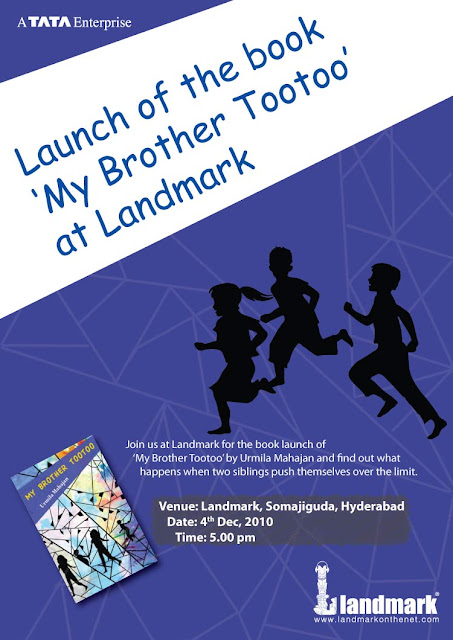
Saturday, December 4, 2010

Friday, June 25, 2010

My Brother Tootoo

Author Urmila Mahajan writes that Tulika's latest My Brother Tootoo is "...all about expecting the unexpected. Tootoo is a late talker but once he begins, there’s no stopping him. Secrets are shared and shielded as he and his elder sister, Rini, meet cheeky Murli, the local presswalla’s son. Despite Rini's disapproval of Murli's wayward and sometimes dishonest disposition, she and Tootoo befriend him, and the three of them end up having a fascinating and terrifying adventure."


What inspired you to write the story?
There’s more than one answer to this question.
In a sense, the story was born when I had to pass time in the car, every day outside my daughter’s tuition. There was this picturesque house on the one side and a park on the other. I started drawing the house one day, and as I sketched, I wondered about the people who lived there. The house, the lane carpeted with crunchy gulmohur pods, the shimmering hot summer air and the park came together in my mind and I started writing.
From another angle, I have shown the possible consequences of ‘breaking the rules’, but more than anything else, I wanted to draw attention to the mystery and wonder of the natural world.

Is it based on true incidents?
The story is a work of fiction but there are certain elements of truth. I knew a child who fell out of a window on the first floor and started talking after that. Only he was younger than Tootoo. By the way, Albert Einstein too was a late talker.
I feel connected to the natural world, just as Rini does and I still love trampling dry leaves when I walk.

Did you set out to write an adventure story? Did it change while you were writing it?
Yes, I did, but I wanted it to be a journey through children’s minds as much as an adventure in the external world.

What were the easiest and hardest parts to write?
The first chapter was the hardest. I started and scrapped many ideas. It got easier as the novel advanced.

Why do you use some of Rini’s diary entries alongside the main narrative?
The story is stretched across a time frame of three years. Rini writes the main story, which is a recollection of the past, while her diary entries wind up the story in the present. I found it interesting to fit the narrative over two distinct time frames. It gave me the freedom to alternate between past and present events to establish connections.

Were Tootoo, Rini and Murli sketched in your mind before you started or did they come to life as the story evolved?
To begin with, I’m afraid they were stilted and wooden. As I spent time with them and wrote and re-wrote chapters, they started moving and talking in my mind. The story took up a life of its own.

Rini is intrigued by the natural world around her. Did you choose to create her like this because these days many of us seem distant from what surrounds us?
It’s a shame how little most of us know about the natural world around us. I think we ought to look at trees and notice the season in which they flower, if and when they shed their leaves, when new leaves are born and what colour they are - more so as trees dwindle in big cities. In a changing world, it’s not too late to turn away from computer screens and look out of the window. Rini evolved out of my intention to draw on the magical quality of the world.

How do you think readers are likely to react to the book? What do you hope they will take away?
It is difficult for me to gauge readers’ reactions. Though the story revolves around children, it is meant for readers of all ages. I hope reading My Brother Tootoo is a positive experience for them and I will be genuinely curious to know their impression of it.

You can find the book on the Tulika site.